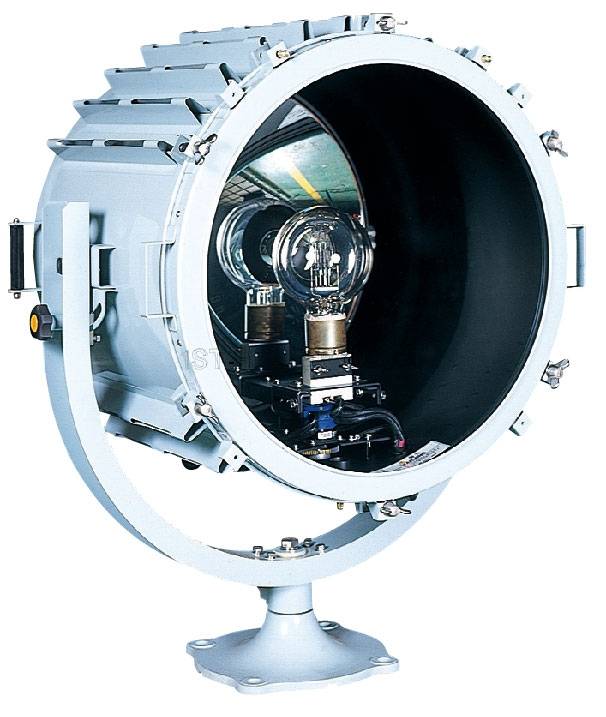
Container lines are heading back through Suez, and for many ships this will be the first transit in more than two years. Before that happens, someone on board needs to look hard at the Suez Canal searchlight. An inspector from the Suez Canal Authority (SCA) tests it before accepting it. If it fails, the ship can be held to daytime transits and delayed.
The numbers explain why this is suddenly urgent. In the first two weeks of October 2026, an average of 753,000 TEU of container ship capacity went through the canal each week, according to BIMCO citing Clarksons Research. That is more than half of the 2023 level for the first time since the Red Sea attacks began. Between February 2024 and mid-2026, weekly container capacity through the canal averaged only about 11% of the 2023 figure. Linerlytica now expects a full return by the first quarter of 2027.
Crews have changed since the last transit, and a searchlight that hasn’t been used in two years may not behave the way it used to. Here is what the rules actually ask for, and how to check your ship before it reaches Port Said or Suez.
What Article 28 says about the Suez Canal searchlight
The requirement sits in Article 28 of the SCA Rules of Navigation. Every vessel needs a searchlight (the rules also call it a projector) before it transits. The full list is longer than most people remember, so here it is in one place.
| Item | What the rule requires |
| Position | On the bow, on the ship’s centreline, lighting the canal clearly |
| Range | A single beam reaching at least 1,800 m ahead (about 1 lux at an atmospheric transmission factor of 0.85) |
| Intensity | At least 3 million candela. That equals a 2,000 W incandescent lamp for ships up to 30,000 Suez Canal gross tonnage (SCGT), or 3,000 W above that |
| Lamp type | Any lamp that meets the range and intensity figures, as long as it is a non-explosive type |
| Reflector | Two halves of ground glass mirror, or polished aluminium with at least 95% of a glass mirror’s reflectivity. Together they give one beam. Parted, they give two beams of at least 5° each, with a dark sector adjustable from 0° to 10° |
| Lamp holder | Two lamp carriers that turn the lamp into the exact focus, with the current switching on automatically |
| Body | Corrosion-resistant drum and stand that move horizontally and vertically, and a hardened front glass that can take rapid cooling |
| Sealing | Watertight (pressure test 0.25 kg/cm²) and gastight, with a vent and a hose connection to carry hot air away. On tankers and ships that are not gas free, the hot air must exit where there is no flammable gas |
| Electrics | First-class marine switches, plug, socket and cables, rated IP55 or similar |
| Paperwork | A type test certificate from a classification society, including an illumination test. The original goes to SCA officials, and an SCA inspector tests the light before accepting it |
Two lines in that table are worth reading twice. The wattage figures are an equivalent, not a hard rule about the bulb. And the type test certificate is not optional paperwork. Without it, the inspector has nothing to accept.
Is an LED Suez Canal searchlight allowed?
Yes, in principle. The rule accepts any kind of lamp that meets the specification. That opened the door to LED units, which run cooler and draw less power than a 2,000 W or 3,000 W lamp.
The rest of the list still applies, though. An LED Suez Canal searchlight still needs the split beam, the 1,800 m range, the sealing and the type test with an illumination test. Honestly, a wattage figure on a datasheet tells you very little here. Ask for the class type test certificate before you order. If a supplier can’t produce one, keep looking.
Cables, socket and power supply
The searchlight is only as good as the circuit feeding it, and the rules cover that too.
The cable run to the searchlight must be permanently fixed, insulated and gastight. At the end of it, there must be a fixed, gastight socket close to the searchlight. Trailing leads and temporary connections don’t pass.
Power matters on some ships as well. If the ship has electric propulsion, or electrically driven steering gear or winches, the generators must keep the searchlight running even if one generator stops. The only exception is an independent generator and circuit set aside for the searchlight. If you are replacing old cable on that run, use proper marine cable and glands rated for the space.
Your own searchlight, or a hired one?
A ship without its own compliant searchlight can hire a portable projector at the canal. The Suez Canal Mooring and Light Company rents them out, and they weigh about 22 kg. But hiring isn’t an option for everyone:
- LPG and LNG carriers must have their own searchlight, without exception.
- Vessels entering the canal direct from sea must also have their own.
- New tugs and yachts up to 1,500 SCGT may transit with their own projectors, provided they carry at least two of at least 1,000 W each.
That last point is where the “two 1,000 W searchlights” idea comes from. It applies to small new tugs and yachts, not to merchant ships in general.
If the ship uses its own searchlight, two shore electricians operate it during the transit. You also need to give them a sheltered place to stay, along with the mooring boat crew.
The other lights the canal looks at
The searchlight gets the attention, but it isn’t the only lighting item in the rules:
- Overhead deck lights must be visible all round the horizon, with a minimum range of 200 m.
- Bridge wing projectors on both sides must show the canal banks clearly, at about 4 lux (at a transmission factor of 0.74) and a minimum range of 200 m.
- The funnel must be lit, so the ship can be identified at night.
- In port at night, the rules ask for the normal COLREG lights plus the canal’s own light signals. For example, a ship asking for a pilot shows three white lights in a vertical line. A dedicated Suez Canal signal light set covers these.
There is also a small detail that catches people out. If a ship has to slow down and may need to stop, the whistle signal at night goes with four to five long flashes from the Aldis lamp or the signal mast lamp. So check that the Aldis lamp and its battery are working too.
What happens if the Suez Canal searchlight fails inspection
If the searchlight or its electrical connections don’t conform, the ship can only transit in daylight. The rules say plainly that this means delay. Repeat failures also attract an extra charge. The amount has changed between editions of the rules, so ask your agent for the current figure.
The rules also say that SCA circulars form part of the regulations. Every merchant ship transiting Suez must use a shipping agent, and the agent will have the latest circulars. It’s worth asking them before you sail, not at anchor.
Suez Canal searchlight checklist before arrival
- Find the original type test certificate and put it with the transit documents.
- Switch the searchlight on and let it run long enough to warm through. Check that the vent and hose clear the hot air.
- Open and close the reflector halves. Confirm you get one beam in the zero position and two beams with an adjustable dark sector when parted.
- Turn both lamp carriers into position and confirm the lamp switches on automatically each time. Carry spare lamps.
- Inspect the socket, plug and cable glands for corrosion, and confirm they are still gastight and IP55.
- Look at the front glass and the drum seals for cracks or perished rubber.
- On electrically propelled ships, confirm the searchlight stays on with one generator off.
- Test the bridge wing projectors, the deck lights, the funnel lighting, the signal lights and the Aldis lamp.
- Prepare a sheltered space for the two shore electricians.
- Ask your agent for the current SCA circulars.
Frequently asked questions
What wattage does a Suez Canal searchlight need?
The rule sets an output, not a bulb. The beam must reach at least 1,800 m with an intensity of 3 million candela. That equals a 2,000 W incandescent lamp for ships up to 30,000 SCGT and 3,000 W for larger ships.
Can I use an LED searchlight in the Suez Canal?
Yes, if it meets the full specification and has a class type test certificate that includes an illumination test. The SCA inspector still tests it on arrival.
Can I hire a Suez Canal searchlight at Port Said?
A ship without its own compliant searchlight can hire a portable projector from the Suez Canal Mooring and Light Company. LPG and LNG carriers, and ships entering direct from sea, must carry their own.
Getting ready in the UAE
If your ship calls at a UAE port before heading for the Red Sea, that is a sensible place to fix a searchlight problem, rather than finding it at Port Said. Oceanic Global Marine Supply in Dubai supplies LED Suez Canal searchlights, Suez Canal signal lights, searchlight reflectors and spare lamps. If you are comparing options, our guide to marine searchlights vs floodlights explains the difference. Or contact our team with your ship’s details.