Lighting plays an important role in marine operations, especially when vessels operate at night or in poor visibility.
Two common lighting solutions are marine searchlights and marine floodlights. Although both are designed to provide powerful illumination, they serve different purposes.
Understanding the difference can help ship operators, marine contractors and offshore facilities choose the right lighting solution.
What Is a Marine Searchlight?
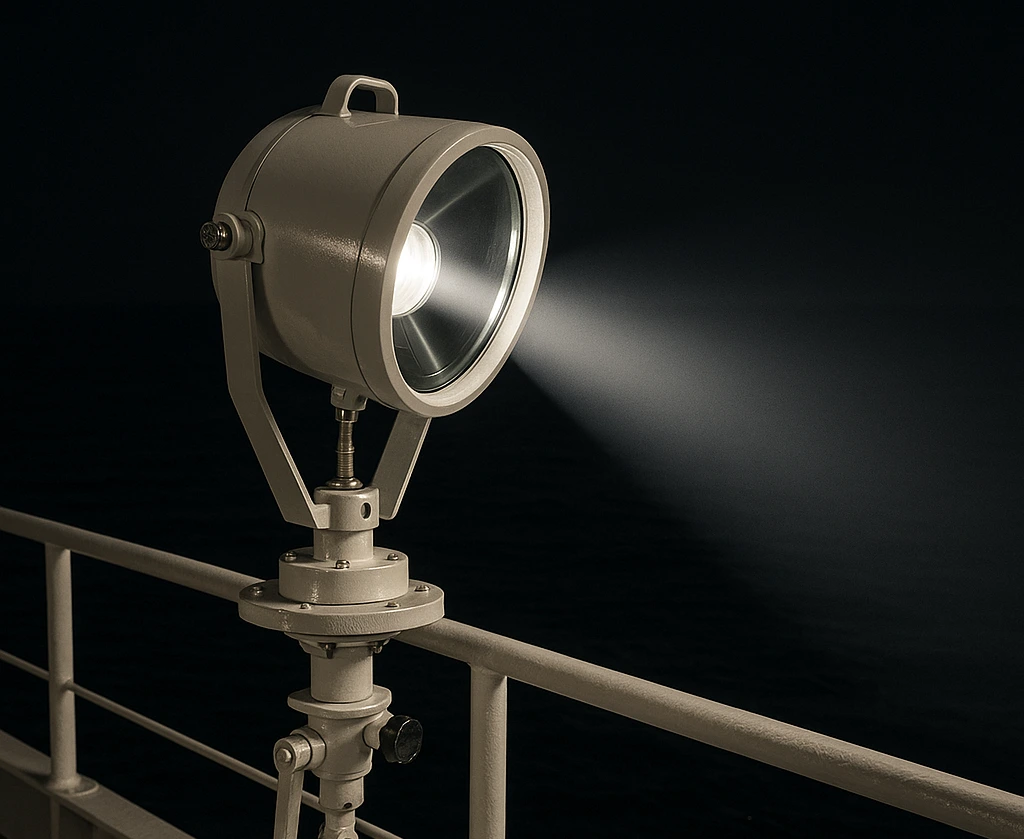
A marine searchlight is designed to produce a concentrated and powerful beam of light over a long distance.
Unlike a floodlight, which spreads light across a wider area, a searchlight focuses illumination toward a specific direction.
Marine searchlights can be used for:
- Long-distance visibility
- Navigation support
- Identifying objects
- Search and rescue
- Port operations
- Vessel manoeuvring
- Offshore operations
- Emergency situations
Modern marine searchlights may use LED technology and can be manually or remotely controlled depending on the model.
Oceanic GMS supplies high-power marine searchlights designed for ships, ports and offshore applications.
What Is a Marine Floodlight?
A marine floodlight is designed to provide broad-area illumination.
Instead of focusing light over a long distance, floodlights spread light across a larger working area.
Typical applications include:
- Ship decks
- Cargo areas
- Walkways
- Offshore platforms
- Shipyards
- Loading zones
- Port facilities
- Maintenance areas
Marine Searchlight vs Marine Floodlight
The key difference is the purpose of the light.
| Feature | Marine Searchlight | Marine Floodlight |
|---|---|---|
| Beam | Narrow and focused | Wide |
| Main purpose | Long-distance visibility | Area illumination |
| Typical use | Navigation, search & rescue | Deck and work areas |
| Coverage | Long range | Wide area |
| Direction | Highly directional | Broad distribution |
| Control | Manual or remote | Usually fixed |
| Best for | Identifying distant objects | Illuminating work zones |
When Should You Use a Searchlight?
A searchlight is the better option when the objective is to illuminate a distant object or specific location.
For example, a vessel may use a searchlight to identify:
- Another vessel
- Buoys
- Floating objects
- Dock structures
- Obstacles
- Shoreline features
- Emergency situations
The concentrated beam allows the operator to direct light where it is needed.
When Should You Use a Floodlight?
Floodlights are more appropriate when the goal is to illuminate a working area.
For example, floodlights can be installed to illuminate:
- Decks
- Cargo handling areas
- Maintenance zones
- Walkways
- Offshore workspaces
- Port operations
A wide beam helps create more uniform illumination across the area.
Why LED Technology Is Popular for Marine Lighting
LED technology is increasingly used in marine lighting because of its efficiency and long operating life.
Important advantages include:
Energy Efficiency
LED lighting can provide high illumination while reducing power consumption compared with older lighting technologies.
Long Service Life
Long operating life can reduce the frequency of lamp replacement.
Reliable Illumination
LED fixtures provide immediate illumination and can be suitable for applications where dependable lighting is important.
Reduced Maintenance
Long-life LED fixtures can help reduce maintenance requirements, particularly in difficult-to-access marine locations.
Remote-Controlled Marine Searchlights
Remote-controlled searchlights can provide additional operational convenience.
Depending on the model, controls may allow operators to change the direction of the beam from a bridge, cabin or control station.
This can be particularly useful when a searchlight is mounted in an elevated or difficult-to-access location.
Oceanic GMS offers marine searchlight solutions with manual, electric and remote-control options depending on the application.
What Should You Consider Before Buying?
Before selecting a marine searchlight or floodlight, consider:
1. Required Beam Distance
If the light needs to illuminate objects at a considerable distance, a searchlight may be more appropriate.
2. Required Coverage
For large working areas, a floodlight may provide better coverage.
3. Installation Location
Consider whether the light will be installed on the deck, mast, bridge, tower or another location.
4. Marine Environment
Saltwater, humidity and corrosion can affect equipment. Marine-grade construction should therefore be considered.
5. Power Supply
Check compatibility with the vessel’s electrical system.
6. Control Requirements
Determine whether manual or remote operation is more suitable.
7. Protection Rating
For exposed marine installations, appropriate IP protection can help protect the fixture from environmental conditions.
Can You Use Both?
Absolutely.
Searchlights and floodlights often complement each other rather than compete with each other.
A vessel may use:
Marine floodlights for deck and work-area illumination.
Marine searchlights for long-range visibility and directional illumination.
Using the appropriate lighting for each application can improve operational visibility and safety.
Marine Lighting Solutions from Oceanic GMS
Oceanic GMS supplies marine lighting solutions for ships, ports and offshore applications.
Its range includes marine searchlights, marine floodlights, navigation lights and explosion-proof lighting.
The company also supplies high-power LED marine searchlights designed for long-distance visibility and demanding marine conditions.
Conclusion
Marine searchlights and floodlights have different purposes.
If you need focused, long-distance illumination, a marine searchlight is generally the better solution. If you need to illuminate a larger working area, a marine floodlight may be more suitable.
For many vessels and offshore facilities, both types of lighting can work together to provide comprehensive illumination.
Looking for marine searchlights or floodlights in the UAE? Contact Oceanic GMS for product recommendations and technical assistance.