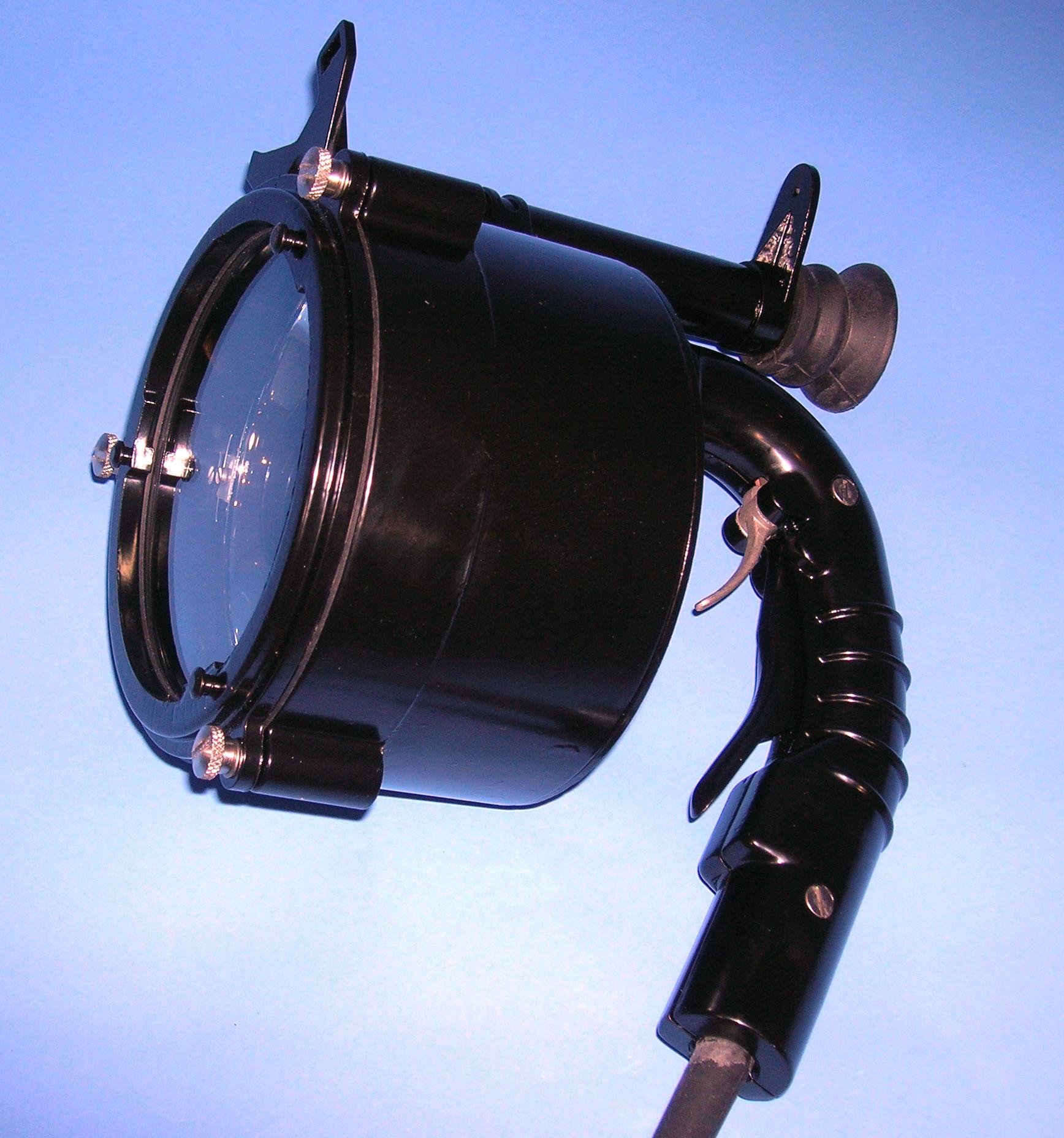
Most people on a bridge call it the Aldis lamp. SOLAS, however, calls it a daylight signalling lamp. Whatever you call it, it is easy to forget about. It lives in a box on the bridge, it rarely gets used, and its battery slowly loses capacity while nobody is looking.
That matters if a surveyor or port state officer asks to see the Aldis lamp working on its own battery. So this guide covers what the rules actually require, the battery questions people keep asking, and a simple check you can run on board.
Is an Aldis lamp mandatory under SOLAS?
Yes, for most ships on international voyages. SOLAS Chapter V, Regulation 19 (paragraph 2.2.2) requires all ships of 150 gross tonnage and upwards, and all passenger ships regardless of size, to carry a daylight signalling lamp. The rule also allows “other means to communicate by light during day and night”. Either way, the power source must not depend solely on the ship’s power supply.
One thing worth knowing: many product datasheets still quote the older SOLAS wording, from before the revised Chapter V came into force in 2002. That version said “ships of over 150 tons gross tonnage, when engaged on international voyages”. The current rule is the one above, and it brings in passenger ships of any size.
The lamp also has to be type approved. The IMO performance standard for it, Resolution MSC.95(72), applies to daylight signalling lamps fitted on or after 1 July 2002.
What MSC.95(72) requires from an Aldis lamp
SOLAS sets the principle, but MSC.95(72) sets the numbers. Here they are in one place.
| Item | What the standard requires |
| Visibility | At least 2 nautical miles by day, at an atmospheric transmission of 0.8. That equals a luminous intensity of 60,000 cd |
| Beam | Axial intensity at least 90% of the maximum. Half angle of divergence no more than 9°, tenth angle no more than 14° |
| Colour | White light within the CIE colour limits set in the standard |
| Switching | Switch-on time plus switch-off time no more than 500 ms |
| Status | An indication of the lamp’s operational status |
| Handling | Usable with gloves on, and the outer parts must not get too hot to hold |
| Power | Not solely dependent on the ship’s main or emergency power. A portable battery weighing no more than 7.5 kg in total, with enough capacity for at least 2 hours |
| Spares | At least three spare illuminants of the type-tested model |
| Construction | Screwed bulb sockets avoided, bulb easy to change in the dark, sight fixed parallel to the optical axis, anti-magnetic materials, and no build-up of condensation |
| Marking | Maker, model and serial number on the lamp. Maker, voltage and power on the bulb |
| Documents | Supplied with technical documentation, including how to check the sight is aligned with the beam |
Two of those lines are easy to miss. The anti-magnetic requirement makes sense on a bridge wing near the compass. And the three spare bulbs must match the type-tested bulb, not just anything that fits the holder.
Aldis lamp battery: the questions people actually ask
What is the SOLAS battery requirement?
SOLAS only says the energy source must not depend solely on the ship’s power supply. The detail, however, comes from MSC.95(72). The lamp needs a portable battery that weighs no more than 7.5 kg complete and can run the lamp for at least 2 hours.
Does an Aldis lamp battery have an expiry date?
Neither SOLAS nor MSC.95(72) sets an expiry date for the battery. What they set is performance: 2 hours of operation. So the real question is whether your battery still delivers that.
Instead of looking for a date, follow the manufacturer’s guidance on battery replacement, and record your run-time tests in the planned maintenance system. If a fully charged battery now runs the lamp for well under 2 hours, replace it. Don’t wait for a date that the rules never gave you.
Can an LED lamp use a built-in battery?
Some approved LED daylight signalling lamps have the battery inside the body. That is fine, as long as the type approval covers the 2-hour requirement and the rest of MSC.95(72). So check the certificate, not the brochure.
What the lamp is used for: signalling by day and night
The IMO standard describes the job simply: passing information between ships, or between ship and shore, by light signals, day and night. The resolution itself notes that ships need these lamps for signalling under the COLREGs, the IAMSAR Manual and the International Code of Signals. So in practice that means Morse by flashing light when radio isn’t an option or isn’t wanted.
There are local rules too. For example, the Suez Canal Rules of Navigation ask a ship that is slowing down and may stop to back up its whistle signal at night with four to five long flashes from the Aldis lamp or signal mast lamp. If your ship is heading back through Suez, our article on Suez Canal searchlight rules covers the other lighting checks.
A simple Aldis lamp check for the bridge team
Here is a routine that covers the rules without taking much time.
- Switch the Aldis lamp on from its battery, not from the charger or ship’s supply.
- Send a few test flashes. The trigger or shutter should feel crisp, and the status indication should work.
- Check the sight alignment using the procedure in the manufacturer’s manual.
- At the interval your planned maintenance system sets, run the lamp on a full charge and time it. You need at least 2 hours.
- Count the spare bulbs. You need three, of the type-tested model, with the right voltage marked on them.
- Check that the lamp’s label still shows the maker, model and serial number clearly.
- Look at the lens, seals, cable and plug for cracks, corrosion or condensation inside.
- Confirm the charger works and the battery case is in good condition.
None of this is complicated. The problem is usually that nobody owns it, so give it a name in the maintenance plan.
Buying an Aldis lamp in Dubai and the UAE
If you are replacing a lamp or its battery, a few questions save trouble later:
- Is the lamp type approved, and does the certificate reference MSC.95(72)?
- What does the complete portable battery weigh, and what run time does the maker state?
- Are three spare bulbs of the approved type included?
- Is a spare battery available, so one can charge while the other is in use?
Oceanic Global Marine Supply in Dubai supplies daylight signal lights and matching socket fittings to ships calling in the UAE. For the wider picture on ship lighting, see our guide to types of navigation lights on ships and offshore vessels. Or contact our team with the make and model on your lamp’s label.
Frequently asked questions
How far should an Aldis lamp be visible?
At least 2 nautical miles by day, at an atmospheric transmission of 0.8. MSC.95(72) puts that at a luminous intensity of 60,000 cd.
How many spare bulbs are required?
At least three. They must also match the bulb the lamp was type tested with.
Is a daylight signalling lamp the same as an Aldis lamp?
In everyday use, yes. “Daylight signalling lamp” is the term in SOLAS and the IMO standard. “Aldis lamp” is what most crews call it.