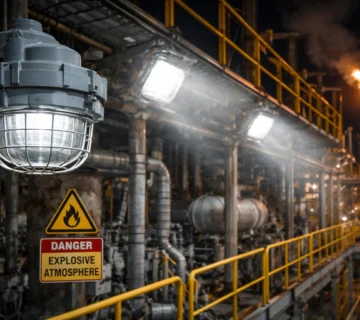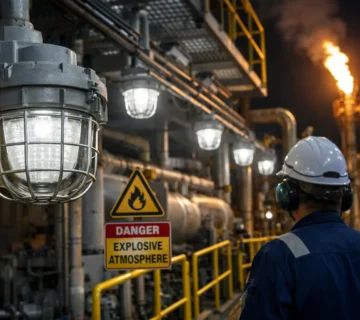
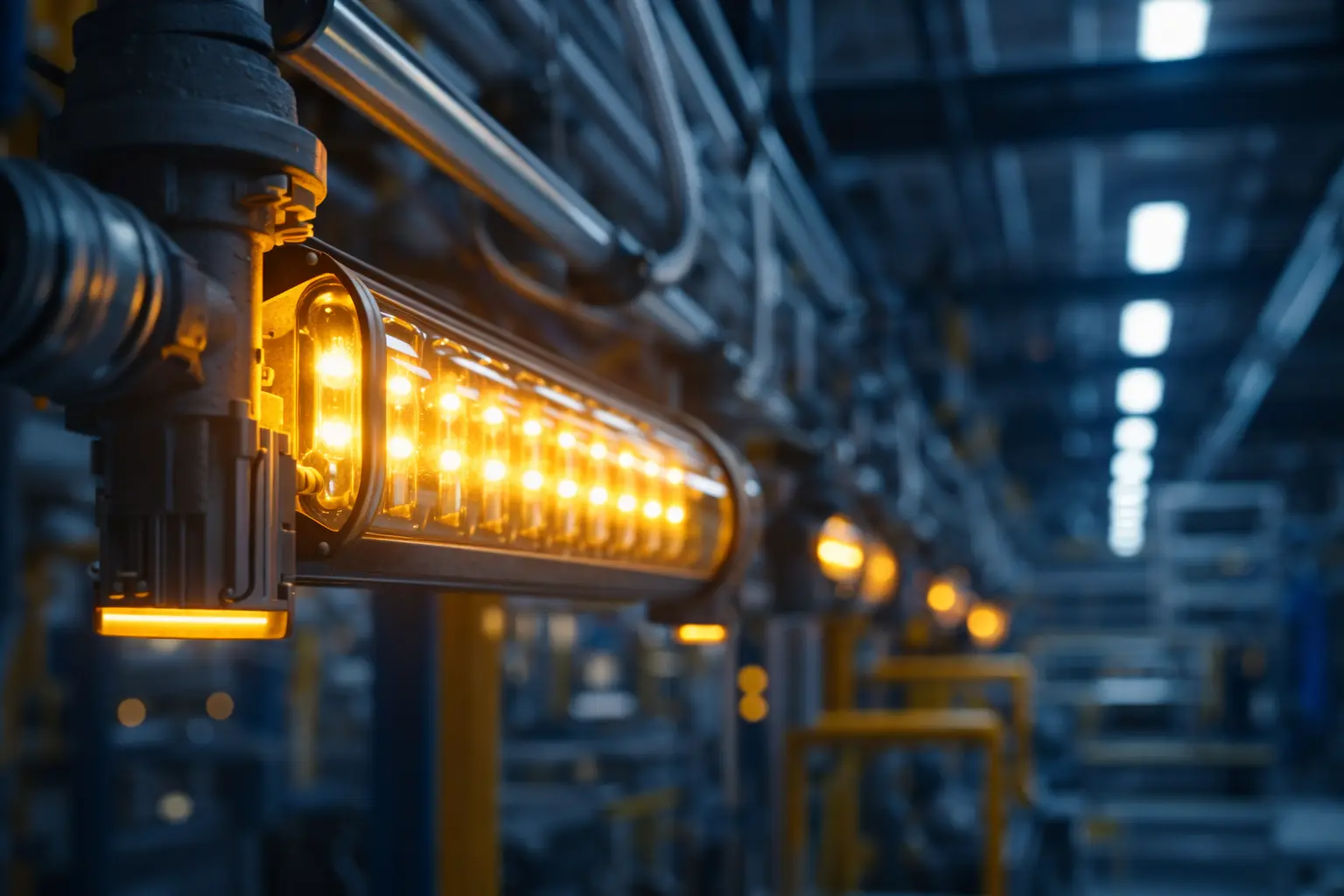
Explosion proof lighting refers to specially designed light fixtures that prevent internal sparks, heat, or flames from igniting flammable gases, vapors, dust, or fibers present in hazardous environments. Unlike regular industrial lights, explosion proof lights are designed to contain any ignition inside the fixture. As a result, the risk of fire or explosion spreading to surrounding areas is significantly reduced.
For this reason, these lighting systems are widely used in industries such as oil and gas, marine operations, chemical plants, refineries, paint booths, and offshore platforms. In such environments, even a small spark can lead to serious accidents.
For industrial and marine facilities looking for certified safety solutions, explosion proof lighting solutions are essential for reducing ignition risks and ensuring compliance in hazardous areas.
Explosion Proof Lighting Definition
In simple terms, proof lighting refers to lighting that is engineered to withstand and contain explosions that may occur inside the fixture. As a result, it prevents flames, sparks, or heat from spreading to the external environment.
This is achieved through:
- Sealed enclosures
- Heavy-duty housing materials
- Controlled heat dissipation
- Certified safety standards
This makes explosion proof lighting essential for locations classified as hazardous areas.
How Does Explosion Proof Lighting Work?
It works by isolating ignition sources from the surrounding atmosphere.
Here’s how:
- Any spark or heat generated inside the light fixture is fully enclosed
- The housing cools escaping gases before they reach the outside
- Strong casings prevent flames from escaping
- Specialized joints and seals stop external flammable substances from entering
As a result, even if an internal ignition occurs, it cannot trigger an external explosion.
Where Is Explosion Proof Lighting Used?
It is commonly used in environments where flammable substances are present, including:
- Oil & gas facilities
- Chemical and pharmaceutical plants
- Marine vessels and offshore platforms
- Paint booths and coating facilities
- Refineries and fuel storage areas
- Grain handling and dust-prone industries
These environments require lighting systems that meet strict safety regulations to protect workers and infrastructure.
In such high-risk environments, choosing the right industrial explosion proof lighting helps maintain safe operations while meeting strict industry regulations.
Explosion Proof Lighting vs Intrinsically Safe Lighting
Although often confused, explosion proof lighting and intrinsically safe lighting are not the same.
| Feature | Explosion Proof Lighting | Intrinsically Safe Lighting |
| Design | Contains explosions | Prevents ignition |
| Power | High power | Low energy |
| Applications | Heavy industrial zones | Control rooms, sensors |
| Cost | Higher | Lower |
It is ideal for high-risk zones, while intrinsically safe lighting suits low-energy environments.
Proof Lighting Standards & Certifications
Explosion lighting must comply with international safety standards, including:
- ATEX (Europe & Middle East)
- IECEx (Global certification)
- Class 1 Division 1 & 2 (North America)
- Zone 0, Zone 1, Zone 2 classifications
These certifications ensure the lighting is safe for use in explosive atmospheres and meets regulatory requirements.
Using certified explosion proof lighting systems ensures compliance with ATEX, IECEx, and international safety standards required for hazardous industrial and marine locations.
Why Explosion Proof Lighting Is Important
Using standard lighting in hazardous areas can lead to:
- Fire hazards
- Equipment damage
- Safety violations
- Serious injuries or fatalities
It also helps in –
- Reduce ignition risks
- Improve workplace safety
- Ensure regulatory compliance
- Maintain uninterrupted operations
For this reason, many industries consider explosion proof lighting a mandatory safety requirement.
Proof Lighting in Industrial and Marine Environments
In industrial and marine settings, lighting must withstand:
- Heat and humidity
- Corrosive chemicals
- Saltwater exposure
- Continuous operation
In such environments, manufacturers design to perform reliably while maintaining consistent illumination and safety.
FAQs – Frequently Asked Questions
Q1. What is explosion proof lighting used for?
Ans – In hazardous areas, industries use lighting to prevent ignition and ensure safe illumination where flammable gases, vapors, or dust are present.
Q2. Is explosion proof lighting mandatory in hazardous areas?
Ans – Yes, in many industrial and marine environments, explosion proof lighting is mandatory to comply with safety regulations and prevent fire or explosion risks.
Q3. Are LED lights explosion proof?
Ans – Standard LED lights are not explosion proof. In other words, manufacturers design and certify only specific LED lights as explosion proof, making them safe for use in hazardous locations.
Q4. What is the difference between explosion proof and flameproof lighting?
Ans – In comparison, manufacturers design explosion proof lighting to contain internal explosions. On the other hand, flameproof lighting focuses on preventing flames from spreading outside the enclosure. In many regions, industry professionals use the terms interchangeably.
Q5. Can explosion proof lights be used outdoors?
Ans – Yes, manufacturers design explosion proof lights for outdoor use, enabling them to withstand extreme weather, moisture, and corrosive environments.
Q6. How do I choose the right explosion proof lighting?
Ans – Choosing the right lighting depends on area classification, certification requirements, environmental conditions, and application needs.