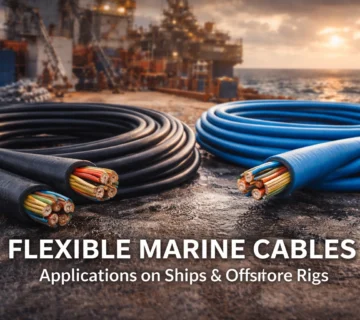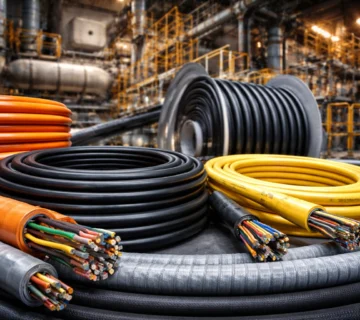

Marine cables play a critical role in powering ships, offshore rigs, navigation systems, and communication equipment. Unlike standard industrial cables, marine cables are engineered to withstand moisture, vibration, chemical exposure, and extreme temperatures.
In this guide, we break down the main types of marine cables, their uses, and how shipowners or offshore contractors can select the right cable for their application.
What Are Marine Cables?
Marine cables are specialized electrical cables designed for harsh marine environments. They resist oil, seawater, UV radiation, corrosion, fire, and mechanical stress — making them essential for both shipboard installations and offshore platforms.
Common uses include –
- Power distribution
- Control & instrumentation
- Communication systems
- Emergency circuits
- Engine room wiring
- Deck machinery
Types of Marine Cables
Below are the most widely used marine cables and where each one is recommended onboard ships and offshore assets.
1. Marine Power Cables
Marine power cables deliver electricity to major systems such as propulsion motors, generators, lighting circuits, and control panels.
Typical applications –
- Main power distribution
- Emergency power systems
- Engine room machinery
- Deck equipment
These cables are designed with flame-retardant and low-smoke materials to prevent fire hazards.
Recommended reading – Marine Electrical Cable Specifications
2. Marine Control Cables
These cables transmit control signals from panels to equipment onboard.
Used for:
- Navigation systems
- Alarm systems
- Communication and monitoring
- Switchboards
Control cables are often multi-core and shielded to reduce interference.
3. Marine Instrumentation Cables
Instrumentation cables are used for low-voltage, sensitive signal transmission.
Applications include –
- Sensors & automation
- Monitoring systems
- Temperature and pressure sensors
- Sounding systems
Instrumentation cables ensure clean and stable data transfer even in high-vibration zones.
4. Flexible Marine Cables (Most Common Onboard)
Flexible marine cables are used where frequent movement or bending occurs.
Applications –
- Portable machinery
- Cranes and winches
- Engine room movable parts
- Temporary power distribution
These cables are designed with rubber or TPE insulation to deliver maximum flexibility.
Explore Flexible Marine Cable Supplier in UAE for more info!!
5. Marine Rubber Cables
Rubber insulated marine cables are chosen for tough applications where abrasion or impact is expected.
Used in –
- Dockside equipment
- Welding machines
- Portable lights & tools
- Offshore construction zones
These cables are highly resistant to oil, heat, and mechanical damage.
Explore Rubber Marine Cable Supplier UAE!!
6. Armoured Marine Cables (High Protection)
Armoured marine cables offer mechanical protection through steel wire or aluminum armor.
Best for –
- Harsh deck environments
- Offshore platforms
- Buried or exposed installations
- Heavy machinery power lines
Armour prevents crushing, tension, and impact damage. Check out Armoured Cable Suppliers in UAE
7. Fire-Resistant & Flame-Retardant Marine Cables
Essential for emergency circuits, ensuring power continuity during a fire.
Used for –
- Fire alarms
- Emergency lighting
- PA/GA systems
- Critical communication
These cables are tested to maintain operation during extreme heat.
8. Communication & Data Marine Cables
Ships rely on these cables for –
- WiFi and networking
- Satellite communication
- Telephone and PA systems
- Navigation and radar data
They may include fiber optic cores for high-speed data transmission.
How to Choose the Right Marine Cable
When selecting marine cables for a project, consider –
1. Application Environment
Engine room, deck, submerged, or dry internal areas all require different insulation levels.
2. Voltage Requirement
Power, control, and instrumentation cables operate at different voltages.
3. Mechanical Stress Level
If the cable will move or face abrasion, choose flexible or rubber cables.
4. Fire & Safety Compliance
Look for –
- IEC/ISO standards
- Flame-retardant or fire-resistant ratings
5. Certification Required
Marine cables often need approvals from –
- ABS
- DNV
- Lloyd’s
- BV
Where Are Marine Cables Used? (Practical Examples)
| Marine Application | Recommended Cable Type |
| Engine Room Power | Armoured cables / Power cables |
| Deck Machinery | Flexible cables |
| Navigation Systems | Instrumentation / Control cables |
| Offshore Platforms | Armoured / Rubber cables |
| Emergency Circuits | Fire-resistant cables |
| Data & Communication | Marine data cables / Fiber optic |
Related Articles
To continue learning about marine electrical systems –
FAQs – Frequently Asked Questions
Q1. What are the main types of marine cables?
Ans – Marine cables include power cables, control cables, instrumentation cables, flexible cables, rubber cables, armoured cables, communication cables, and fire-resistant cables.
Q2. Which marine cable is best for offshore platforms?
Ans – Armoured marine cables or rubber-insulated cables are best because they provide maximum protection against mechanical stress, moisture, and corrosion.
Q3. What is the difference between flexible and armoured marine cables?
Ans – Flexible cables are designed for movement and bending, while armoured cables are designed for protection against mechanical impact, compression, and harsh external environments.
Q4. Are marine cables fire-resistant?
Ans – Many marine cables are flame-retardant or fire-resistant to ensure continuity of power during emergencies.
Q5. Where can I buy marine cables in UAE?
Ans – You can purchase marine cables from Oceanic GMS, offering flexible, rubber, armoured, and high-performance marine cables across Dubai, Abu Dhabi, and Sharjah.