
Choosing the right armoured cable is critical for safety, electrical performance, and long-term reliability — especially in marine, offshore, and industrial environments. Most buyers struggle to choose between the two most widely used armoured cables — SWA (Steel Wire Armoured) and AWA (Aluminium Wire Armoured).
In this guide, we break down the construction, performance, advantages, and ideal use cases of SWA vs AWA cables, helping engineers, technicians, and procurement teams make the right decision.
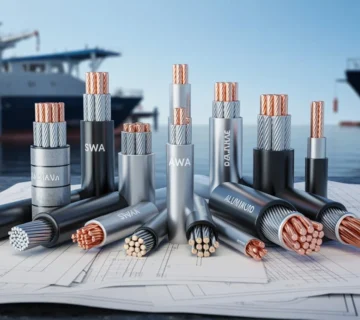
What Is SWA Cable? (Steel Wire Armoured Cable)
SWA cables use steel wires in the armour layer, giving them very high mechanical strength and excellent resistance to impact, crushing, and external stress.
Key Characteristics of SWA Cables
- Heavy-duty mechanical protection
- Ideal for underground installations
- Suitable for low-voltage power distribution
- Available in XLPE and PVC insulation
- Better tensile strength than AWA
Where SWA Cables Are Used
- Underground electrical networks
- Construction sites
- Industrial power distribution
- Machinery and heavy equipment
- Outdoor and harsh environments
If your priority is mechanical strength, SWA is almost always the better choice.
What Is AWA Cable? (Aluminium Wire Armoured Cable)
AWA cables use aluminium wires instead of steel, making them lighter and easier to handle. They are primarily designed for high-voltage applications where magnetic interference must be minimized.
Key Characteristics of AWA Cables
- Lightweight compared to SWA
- Lower cost and easier to install
- Does not cause magnetic interference
- Ideal for single-core high-voltage cables
Where AWA Cables Are Used
- High-voltage electrical distribution
- Power stations and substations
- Marine and offshore vessels (single-core HV systems)
- Applications requiring low weight and easy installation
In single-core HV systems, AWA is not just preferable — it’s required due to magnetic field considerations.
SWA vs AWA: Key Technical Differences
| Feature | SWA (Steel Wire) | AWA (Aluminium Wire) |
| Armour Material | Steel | Aluminium |
| Weight | Heavy | Lightweight |
| Cost | Higher | Lower |
| Magnetic Field Suitability | Not ideal for single-core | Excellent for single-core |
| Voltage Suitability | Low/medium voltage | Medium/high voltage |
| Mechanical Protection | Very strong | Moderate |
| Installation | Tougher | Easier |
Which Is Better for Marine Applications?
For ships, offshore rigs, and harsh marine environments:
➡️ SWA is preferred when:
✔ High mechanical protection is needed
✔ Cables are exposed to movement or friction
✔ Installed on deck, engine rooms, or outdoor systems
➡️ AWA is preferred when:
✔ Single-core HV cables are used
✔ Weight reduction is essential
✔ Magnetic interference must be minimized
Marine environments often require a mix of both depending on circuit design and safety standards. Want to learn more about armour types? Read our detailed guide on the Types of Armoured Cables & Their Applications
Which Armoured Cable Should You Choose?
Choose SWA if you need:
- Mechanical protection
- Underground or outdoor installation
- Heavy-duty performance
Choose AWA if you need:
- Lightweight cable
- High-voltage single-core systems
- Reduced electromagnetic interference
For a complete overview of certified cable suppliers in the region, visit our Armoured Cable Suppliers in UAE page.
FAQs – Frequently Asked Questions
Q1. What is the main difference between SWA and AWA cables?
Ans – SWA uses steel armour for strong mechanical protection, while AWA uses aluminium armour for lightweight and high-voltage applications.
Q2. Is SWA or AWA better for underground use?
Ans – Use SWA in underground installations since it delivers stronger impact and crush resistance than AWA.
Q3. Can AWA cables be used for marine applications?
Ans – Use AWA for single-core high-voltage systems because it minimizes magnetic interference.
Q4. Which cable is more cost-effective?
Ans – AWA cables are generally more affordable and easier to install.
Q5. Do both SWA and AWA meet marine and industrial standards?
Ans – Yes, when supplied by certified manufacturers, both comply with IEC, BS, and marine-grade standards.