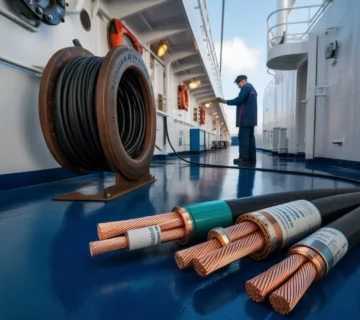

Choosing the right cable for offshore, vessel, or subsea applications can be confusing — especially when terms like marine cable and submarine cable sound similar.
But in reality, the two serve completely different functions, follow different engineering standards, and are designed for different risk environments.
This guide breaks down the exact differences, use-cases, technical parameters, and when you should use each cable type.
What Is a Marine Cable?
A marine cable is an electrical or communication cable designed for ships, offshore platforms, and marine vessels.
These cables must withstand:
- Moisture & saltwater exposure
- Oil, vibration, and mechanical stress
- High temperatures
- Flame retardancy requirements
They are certified under IEC 60092 marine standards.
Common Applications of Marine Cables:
- Vessel power distribution
- Navigation systems
- Engine room wiring
- Control & instrumentation
- Offshore oil & gas rigs
What Is a Submarine Cable?
A submarine cable is a high-capacity fiber-optic or power transmission cable laid under the seabed for long-distance communication or energy transfer.
These cables require advanced engineering due to:
- Extreme water pressure
- Ocean currents
- Marine life impact
- Undersea seismic activity
Common Applications of Submarine Cables:
- International internet & data transmission
- Offshore wind farm power export
- Inter-continental power connections
- Undersea communication networks
Marine Cable vs Submarine Cable (Quick Comparison Table)
| Feature | Marine Cable | Submarine Cable |
| Purpose | Ship/offshore wiring | Undersea data or power transmission |
| Environment | Shipboard, offshore, above water | Deep seabed (up to thousands of meters) |
| Construction | Flame-retardant, oil-resistant | Steel-armored, pressure-resistant, waterproof |
| Voltage Level | Low/medium voltage | Medium/high voltage & fiber optic |
| Length | Short runs on vessels | Hundreds to thousands of kilometers |
| Installation | Onboard with clamps & trays | Seabed trenching & ROV-assisted |
| Certifications | IEC 60092, Lloyd’s Register | ITU Submarine Cable Standards |
Technical Differences Explained
1. Construction
Marine cables use:
- XLPE/EPR insulation
- Tinned copper
- Halogen-free sheathing
- Fire resistance (IEC 60331)
Submarine cables use:
- Multi-layer steel armoring
- Water-blocking tapes
- Copper/optical fibers
- Polyethylene outer sheathing
2. Voltage & Data Handling
- Marine cables: up to 33 kV
- Submarine power cables: 220 kV – 525 kV
- Submarine data cables: multi-terabit fiber optic cores
3. Mechanical Strength
Submarine cables must survive:
- Anchor drops
- Fishing trawlers
- Sea current abrasion
- Deep-sea pressure
Marine cables face vibration & heat but not deep-sea forces.
4. Installation Method
- Marine cables are installed manually on ships.
- Submarine cables need specialized vessels, ROVs, and seabed trenching tools.
Which One Should You Use? (Simple Rule)
If the cable is inside a vessel, ship, platform, or any offshore structure, choose -t👉 Marine Cable
If the cable must transmit power or data through the ocean, choose -👉 Submarine Cable
Why This Difference Matters (Real-World Examples)
Example 1 – Shipboard Power Wiring
Use marine cables like Unika marine cable, MESC, or OGMAX rubber cable built for vibration, bending, and fire resistance.
Example 2 – Undersea Fiber-Optic Internet
Use submarine cables engineered for thousands of kilometers of underwater distance.
Example 3 – Offshore Wind Farms
Use submarine power export cables from turbine to onshore grid.
Marine Cable Use-Cases in the UAE
Oceanic GMS supplies marine-grade cables across:
- Shipyards in Dubai & Sharjah
- Offshore oil & gas platforms
- Marine service companies in Abu Dhabi
- Industrial marine electrical contractors
Trusted by engineers for durability, compliance, and marine safety.
FAQs – Frequently Asked Questions
Q1. What is the main difference between marine and submarine cables?
Ans – Marine cables are used on vessels; submarine cables are used under the ocean for long-distance power or data transmission.
Q2. Are marine cables waterproof?
Ans – Yes, marine cables have moisture-resistant and flame-retardant sheathing designed for shipboard environments.
Q3. Are submarine cables armored?
Ans – Yes, they include steel wire armoring to survive abrasion, anchors, fishing nets, and deep-sea pressure.
Q4. Which cable is used for undersea internet?
Ans – Fiber-optic submarine cables.
Q5. Can marine cables be used underwater?
Ans – Only for limited, shallow, and temporary exposure — not for long-distance seabed installations.
Q6. Who supplies marine cables in the UAE?
Ans – Oceanic GMS supplies certified marine-grade cables across Dubai, Abu Dhabi, and Sharjah.