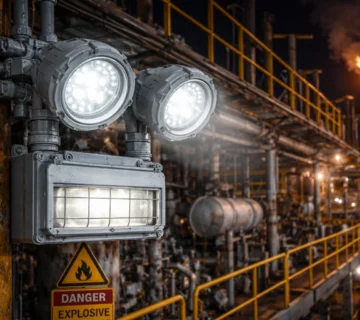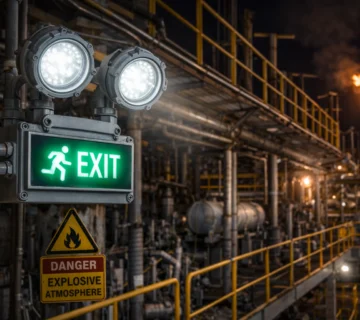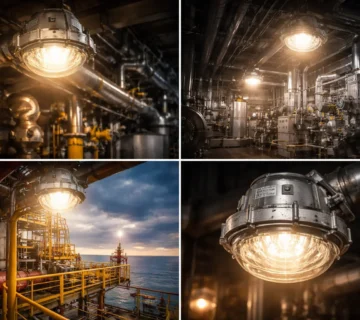
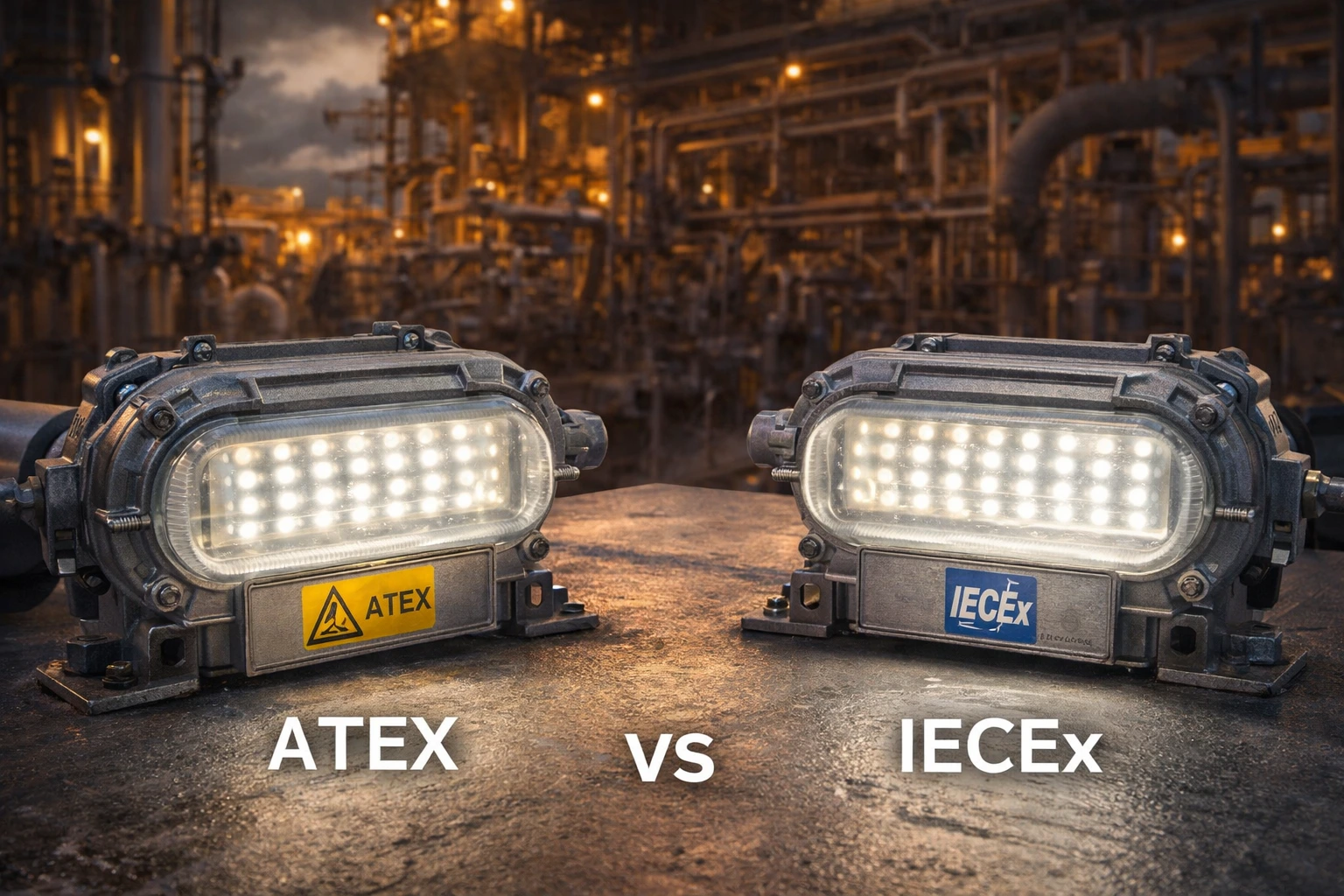
Explosion proof LED lighting must meet strict safety standards to operate in hazardous environments. In industries such as oil and gas, marine, and chemical processing, lighting systems must prevent ignition risks caused by flammable gases or dust. For this reason, certifications like ATEX and IECEx are essential for ensuring safety and compliance.
What Is ATEX Certification?
ATEX is a European certification standard for equipment used in explosive atmospheres. It ensures that products meet safety requirements defined by the European Union.
ATEX covers:
- Equipment used in hazardous zones
- Gas and dust explosion environments
- Safety design and testing requirements
Because ATEX is mandatory in Europe, many manufacturers design products to comply with this standard.
What Is IECEx Certification?
IECEx is an international certification system that ensures equipment safety in hazardous areas. It is widely accepted across multiple countries outside Europe.
IECEx focuses on:
- Global safety compliance
- Equipment testing and certification
- International standardization
As a result, IECEx-certified products are suitable for use in global industrial markets.
Key Differences Between ATEX and IECEx Explosion Proof Lighting
Although both certifications ensure safety, there are important differences.
🔹 Regional vs Global Acceptance
ATEX is primarily used in Europe, while IECEx is internationally recognized.
🔹 Certification Process
ATEX follows EU directives, whereas IECEx uses international standards and certification schemes.
🔹 Documentation and Compliance
IECEx provides more globally standardized documentation compared to ATEX.
🔹 Application Scope
Both certifications apply to hazardous environments, but IECEx offers broader global usability.
Why Certification Matters
Certification plays a critical role in ensuring safety. In hazardous environments, even a small spark can cause serious accidents.
ATEX and IECEx certifications ensure:
- Equipment does not ignite explosive atmospheres
- Compliance with safety regulations
- Reliable performance in extreme conditions
Because safety is critical, certified lighting is mandatory in high-risk industries.
Choosing Between ATEX and IECEx Explosion Proof Lighting
The choice depends on the region and project requirements. For this reason, businesses select certification based on where the equipment will be used.
- Use ATEX-certified lighting for European operations
- Use IECEx-certified lighting for international projects
Many manufacturers offer products that meet both standards.
Applications
These lighting systems are widely used in hazardous industries.
Common applications include:
- Oil and gas facilities
- Offshore platforms
- Chemical plants
- Marine vessels
- Refineries
Because these environments are high-risk, certified lighting is essential.
Final Thoughts
Understanding the difference between ATEX and IECEx helps businesses select the right explosion proof LED lighting. As a result, industries can ensure compliance, improve safety, and operate efficiently in hazardous environments.
For safe and compliant operations, industries rely on certified explosion proof LED lights designed to meet both ATEX and IECEx standards.
FAQs – Frequently Asked Questions
Q1. What is the difference between ATEX and IECEx?
Ans – ATEX is a European certification standard, while IECEx is an international certification system for hazardous area equipment.
Q2. Is IECEx accepted worldwide?
Ans – Yes. IECEx certification is widely accepted across multiple countries and industries globally.
Q3. Is ATEX mandatory?
Ans – ATEX certification is mandatory for equipment used in explosive environments within the European Union.
Q4. Can equipment have both ATEX and IECEx certification?
Ans – Yes. Many explosion proof lighting products are designed to comply with both ATEX and IECEx standards.