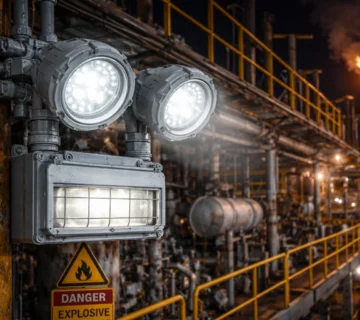
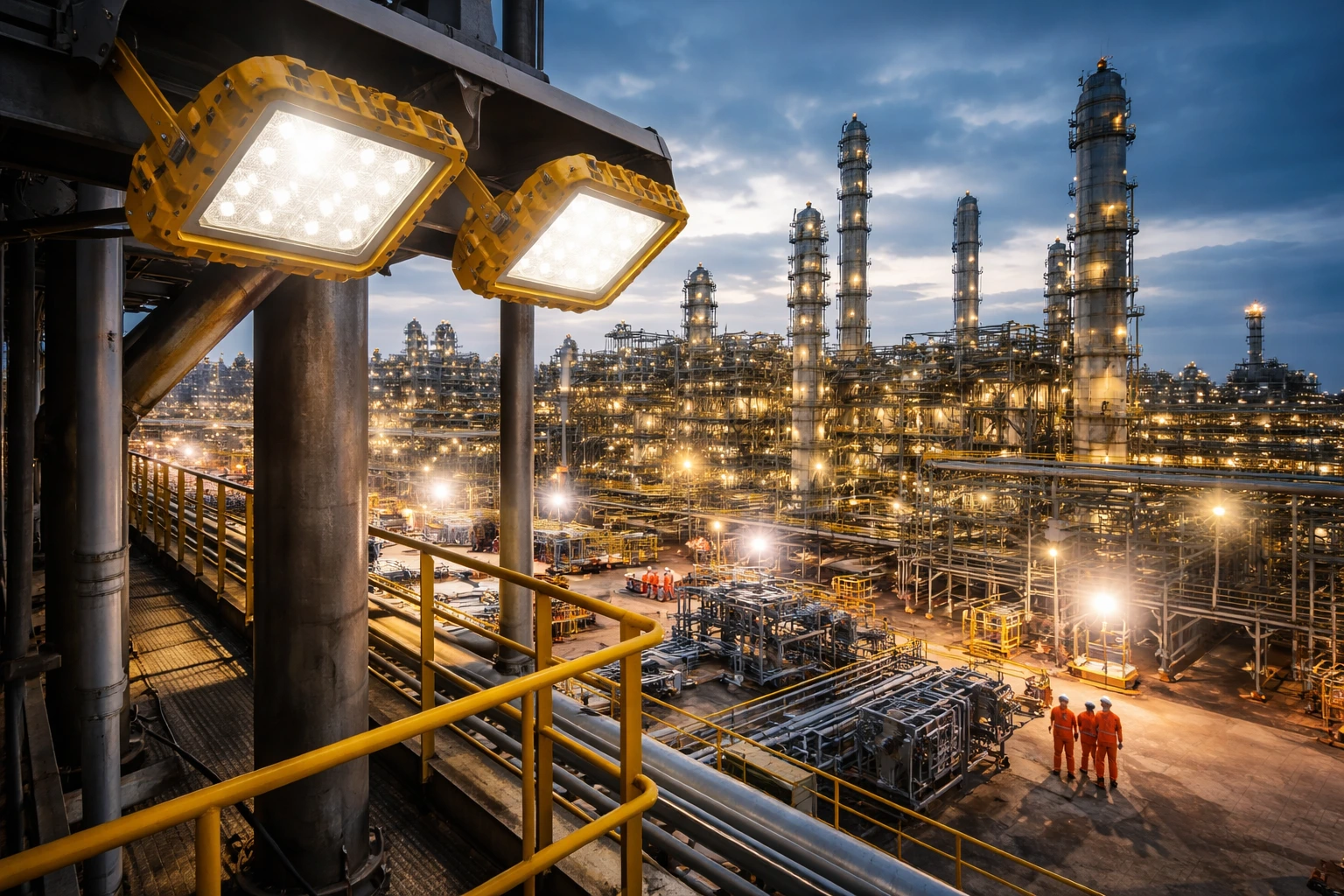
Large industrial and hazardous environments require lighting systems that combine high illumination output with strict safety compliance. Facilities such as oil refineries, offshore platforms, chemical plants, fuel storage terminals, and marine docks operate in classified hazardous zones where flammable gases, vapors, or combustible dust may be present.
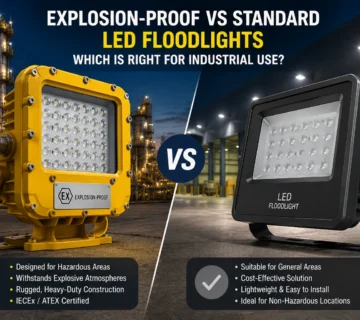
In such conditions, standard flood lights are not suitable. Explosion Proof LED Flood Lights are specifically engineered to deliver powerful illumination while preventing ignition risks in hazardous atmospheres.
Why Large Hazardous Areas Require Specialized Flood Lighting
Large industrial zones typically include:
- Storage tank farms
- Offshore deck areas
- Processing units
- Loading terminals
- Warehouses storing volatile materials
- Marine dockyards
These areas require wide beam coverage and high lumen output to ensure visibility and worker safety. However, lighting fixtures installed here must also meet hazardous area safety standards.
Explosion-proof flood lights are designed with reinforced enclosures capable of containing internal sparks or arcs, ensuring that any electrical fault does not ignite the surrounding atmosphere.
Key Features of Explosion Proof LED Flood Lights
Modern explosion-proof LED flood lights offer several technical and operational advantages:
1️. High Lumen Output
Designed to illuminate large open areas with uniform light distribution.
2️. Heavy-Duty Housing
Constructed with corrosion-resistant materials suitable for offshore and marine environments.
3️. Zone Compliance
Suitable for Zone 1 and Zone 2 hazardous locations depending on certification.
4️. Energy Efficiency
LED technology reduces energy consumption while maintaining brightness levels.
5️. Low Heat Emission
Lower surface temperature reduces ignition risk.
6️. Long Lifespan
Extended operating life minimizes maintenance in hard-to-access hazardous areas.
Each explosion light fixture must be selected based on hazardous zone classification, mounting height, and environmental exposure to ensure optimal flood coverage and safety compliance.
Applications in Hazardous Industrial Environments
Explosion proof LED flood lights are widely used in:
- Oil & Gas refineries
- Offshore drilling rigs
- Marine vessels & ports
- Chemical processing facilities
- LNG terminals
- Fuel depots
In offshore and marine applications, lighting systems must also withstand saltwater exposure, vibration, humidity, and extreme temperatures.
In offshore and dockside installations, these flood lights operate alongside power infrastructure supported by marine cable suppliers in uae to maintain uninterrupted and compliant electrical systems.
Zone 1 vs Zone 2 – Why It Matters
Hazardous locations are categorized based on the likelihood of explosive atmospheres:
- Zone 1: Explosive atmosphere likely during normal operation
- Zone 2: Explosive atmosphere unlikely but possible under abnormal conditions
Selecting the correct flood light specification based on zone classification is critical for compliance and safety.
Advantages Over Traditional Flood Lighting
Compared to conventional industrial flood lights, explosion-proof LED models offer:
- Improved safety certification
- Reduced power consumption
- Lower maintenance frequency
- Enhanced durability
- Better optical performance
For large hazardous areas, these benefits directly translate into operational efficiency and reduced risk.
Factors to Consider Before Installation
When selecting explosion-proof LED flood lights, consider:
- Hazardous area classification (Zone 1 / Zone 2)
- Required lumen output
- Mounting height
- Beam angle
- Environmental exposure (marine, desert heat, chemical vapors)
- Certification standards
Proper lighting design ensures adequate illumination without compromising safety compliance.
Supporting Safe Industrial Operations
As industrial infrastructure continues to expand across offshore and hazardous environments, reliable lighting solutions remain a critical component of safety planning. Explosion proof flood lights not only enhance visibility but also reduce ignition risk, improve energy efficiency, and support long-term operational reliability.
Investing in certified flood lighting systems ensures that large hazardous areas remain well-lit, compliant, and safe for personnel and equipment.
FAQs – Frequently Asked Questions
Q1. What are explosion proof LED flood lights?
Ans – Explosion proof LED flood lights are heavy-duty lighting fixtures designed to safely operate in hazardous areas containing flammable gases or vapors.
Q2. Where are explosion proof flood lights used?
Ans – They are commonly installed in oil refineries, offshore platforms, chemical plants, fuel depots, and marine dockyards.
Q3. What is the difference between Zone 1 and Zone 2 lighting?
Ans – Zone 1 areas have a higher likelihood of explosive atmospheres during normal operations, while Zone 2 areas have lower probability but still require certified equipment.
Q4. Are LED flood lights better for hazardous areas?
Ans – Yes. LED flood lights consume less energy, generate lower heat, and provide longer operational lifespan compared to traditional lighting.